


The Siege of Silence: Iran’s Fractured Front and the "Economic Bomb"

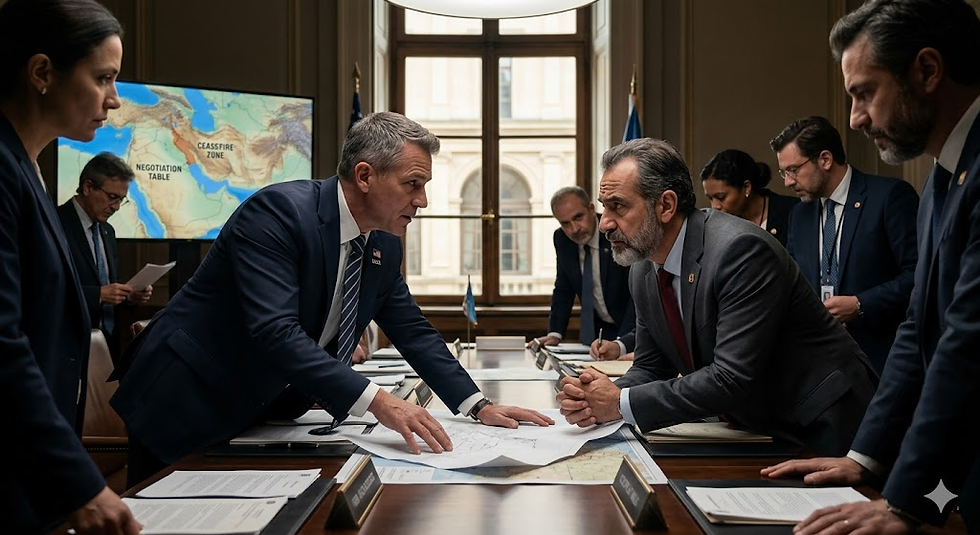
President Donald J. Trump has officially extended the ceasefire with Iran, a move prompted by a high-stakes request from Pakistani leaders Field Marshal Asim Munir and Prime Minister Shehbaz Sharif. While the physical attack is on hold, the message from Washington is clear: the U.S. naval blockade remains a stranglehold, and Iran’s leadership is currently a ship without a captain.
In the Presidents words from truth Social:
STATEMENT OF PRESIDENT DONALD J. TRUMP:
Based on the fact that the Government of Iran is seriously fractured, not unexpectedly so and, upon the request of Field Marshal Asim Munir, and Prime Minister Shehbaz Sharif, of Pakistan, we have been asked to hold our Attack on the Country of Iran until such time as their leaders and representatives can come up with a unified proposal. I have therefore directed our Military to continue the Blockade and, in all other respects, remain ready and able, and will therefore extend the Ceasefire until such time as their proposal is submitted, and discussions are concluded, one way or the other. President DONALD J. TRUMP
The IRGC and the Crisis of Command
The Iranian leadership is suffering from a paralyzing internal fracture. The Islamic Revolutionary Guard Corps (IRGC), the ideological and military muscle of the nation, is increasingly at odds with a crumbling civil government.
The Leaderless Void: Without a unified voice capable of making firm commitments, Tehran is stuck in a loop of internal deliberation.
Paralysis by Committee: No single faction wants to take the fall for the concessions required to end the blockade, leaving the U.S. delegation in Islamabad waiting for a "true leader" to step to the table.
Economic Fury: The "Kinetic" Financial Strike
While the military remains "ready and able," the Treasury Department has moved the battlefield into the global ledger. Secretary of the Treasury Scott Bessent recently unveiled "Operation Economic Fury," a campaign designed to be the "financial equivalent" of a kinetic bombing run.
Bessent has signaled an aggressive new phase of economic statecraft, stating that the Treasury is moving in a "kinetic way" to dismantle the regime’s shadow banking networks. By hunting down the private bank accounts of IRGC leadership and their global proxies, Bessent is placing a permanent stranglehold on the regime’s ability to move even a single dollar. For the first time, the U.S. is treating illicit finances not just as a violation, but as a military target—systematically neutralizing bank accounts and proxy front companies with the same precision as a drone strike.
Market Implications: The "Peace Pivot"
For the markets, this extension is the ultimate "Oxygen."
Reduced Risk Premium: The threat of immediate regional war has been replaced by a "diplomatic window," causing a relief rally in global equities and a stabilization in energy prices.
The Path Forward: As long as the ceasefire holds, the "flight to safety" is reversing. We are seeing a massive shift back into risk-on assets like Bitcoin (back to $78k) and high-growth tech as the world bets on a "Peace Treaty" over a "Firestorm."
The Bottom Line
The U.S. is giving Tehran a choice: find a leader to sign the deal, or continue to watch the nation’s economy dissolve. As the administration has proven, the economic pain being inflicted on the IRGC’s coffers is proving to be just as powerful as bombs.



Comments